
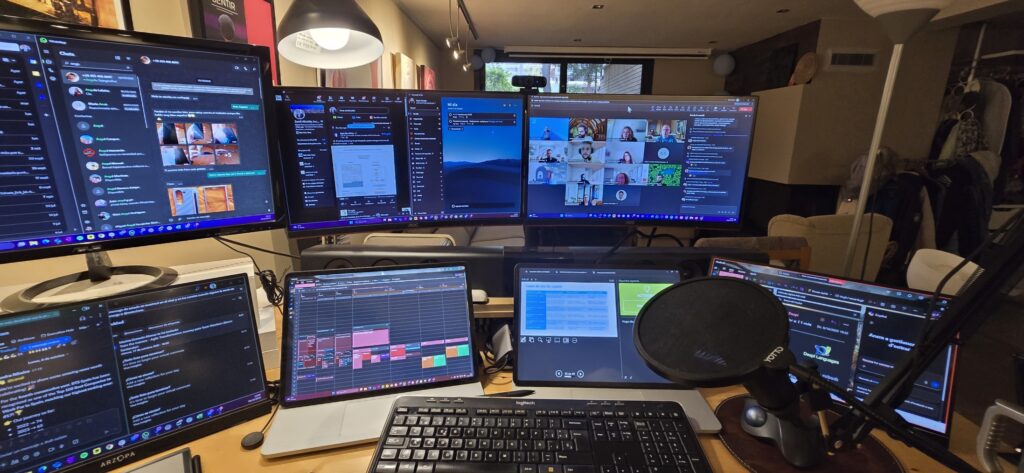
This is a personal pause.
It’s not about frameworks, productivity hacks, or the latest tools. It’s about something far more mundane—and far more influential than we usually admit: my workspace.
The image that accompanies this article shows my real setup. It’s not designed for Instagram, nor does it follow any extreme minimalist ideal. It exists for one very specific reason: to reduce cognitive friction and help me sustain focus during days that mix thinking, creating, coordinating, and facilitating.
It may look complex at first glance.
It isn’t.
It’s intentional.
Over the years, I used to think that productivity lived mostly in my head. The desk was secondary. A surface. A place to put things.
Experience has taught me the opposite: the workspace thinks with me.
Cognitive psychology has long shown that our working memory is limited. Every unnecessary decision—where is that document, which window should I look at, what deserves my attention right now—consumes mental resources that should be devoted to meaningful work. A well-designed environment reduces that invisible tax.
Related theories go even further, suggesting that cognition is not confined to the brain alone. When information is distributed intelligently in the environment, the mind offloads effort. The workspace becomes an external support system, not a distraction.
That’s why a good setup isn’t about having less.
It’s about making the right things visible at the right time, and keeping everything else out of the way.
My desk doesn’t aim for visual silence.
It aims for functional coherence.
More screens doesn't mean more distraction.
More screens doesn't mean more distraction.
Research suggests something more nuanced.
The real cognitive cost doesn’t come from having information available. It comes from unintentional task switching. Studies on multitasking consistently show that the brain pays a price every time it jumps between tasks without clear intent.
Visibility isn’t the enemy. Ambiguity is.
In my case, screens don’t compete with each other. They share responsibilities. Some hold context. Others are dedicated to creation. Others support communication or monitoring. Each has a role—one that can change depending on what I’m doing.
I’m not multitasking.
I’m eliminating constant micro-decisions.
Another important point: my setup is not static.
It changes with the activity.
I don’t work the same way when I’m writing as when I’m facilitating. I don’t need the same environment for deep thinking as I do for coordination or execution. Screens shift roles. Some disappear entirely. Others move to the background.
The setup adapts to the type of cognitive effort required in that moment.
That’s why I don’t see a workspace as a snapshot.
It’s a living system.
For a long time, we’ve confused productivity with extreme simplification—as if order could only exist in emptiness.
My experience suggests otherwise.
Well-designed complexity isn’t noise. It’s leverage.
It’s not about having more.
It’s about every element earning its place.
Well-designed complexity isn't noise. It's levarage.
Well-designed complexity isn't noise. It's levarage.
This setup isn’t meant as a universal recommendation. It’s simply the result of years of paying attention to where I lose focus, where friction appears, and what helps me sustain attention in complex work.
In the next article, I’ll go into detail about how I structure my screens, what role each one plays, and how that structure changes depending on the activity.
If you want to try a small experiment in the meantime, do this for a week:
notice which elements in your workspace force you to make constant decisions, which ones steal attention without adding value, and ask yourself:
What friction could I remove without oversimplifying?
Sometimes, better focus doesn’t come from removing things.
It comes from giving them meaning.
References & further reading
(All links are publicly accessible)
American Psychological Association – Multitasking
https://www.apa.org/research/action/multitask
Explains why the main cognitive cost comes from task switching, not from information availability.Cognitive Load Theory
https://es.wikipedia.org/wiki/Teor%C3%ADa_de_la_carga_cognitiva
Introduces the concept of limited working memory and the importance of reducing unnecessary mental load.Worked-Example Effect (Cognitive Load Theory)
https://en.wikipedia.org/wiki/Worked-example_effect
Shows how structured information reduces cognitive effort.Perceptual Load Theory
https://es.wikipedia.org/wiki/Teor%C3%ADa_de_la_carga_perceptual
Explains how attentional resources are finite and prioritized.Is Google Making Us Stupid? – cultural reference on attention
https://en.wikipedia.org/wiki/Is_Google_Making_Us_Stupid%3F
A widely cited debate on how information structure influences attention and deep thinking.